
Plant line, 24/7 +1-555-0164[email protected]
§1 FAQQuestion register / Reviewed Oct 2026
These are the questions plant managers and controls leads ask us most, in their words. Start with the group you need, or ring the plant line and ask an engineer.
§2 Before you buy5 questions
What we do, which plants we fit, and what stays as it is.
We secure control networks at plants that cannot stop. We listen to the network passively, draw it into zones and conduits, and make every change inside a window your plant manager signed.
Yes. Mail, laptops and the office network stay with your IT team. We agree the boundary at the plant DMZ and write it down.
Plants that run long shifts and cannot stop on demand: power, water, pipelines, manufacturing, and food and drink. Industries shows the rules we map to for each.
No. We work with what is installed, including units nobody can patch. Where a fix is not possible, we shield the device with zone rules instead.
Yes. Site report SR-214 is on this site. The client is fictional. The format is the one you would get.
§3 Plant incidents5 questions
Who answers, who decides, and what lands on your desk afterwards.
An engineer on the plant line rota, day and night. No menu and no call centre.
Whether anyone is at risk, and whether the process is in a safe state. The network comes after that, every time.
Not without your operations lead. We say what we see and what we would do, and they decide. A safe process comes before a contained network.
A note to your shift lead the same night, then the full report: timeline, findings, what we did, who approved it and what to do next.
Call the line. We will tell you what we can do, and scope any paid work before it starts.
§4 On your floor6 questions
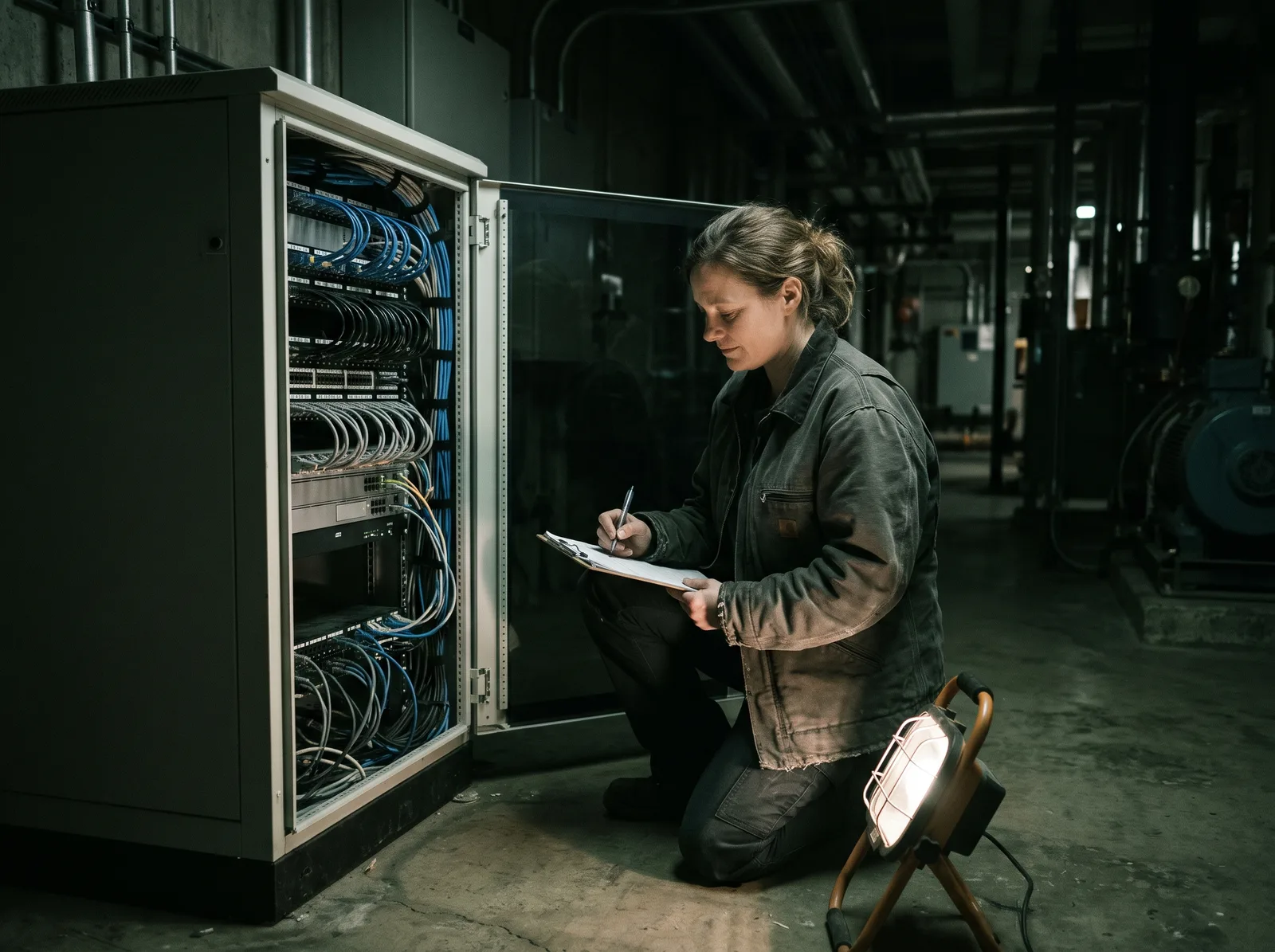
What we touch, what we never touch, and who stands beside us when we do.
No active scans on a live line. We learn the network from a copy of its traffic, so old controllers never see us. That is rule R1.
No. Nothing goes on a PLC, drive or safety system, so your vendor support stays intact. The sensor sits on a mirror port or a hardware tap.
No. It goes on a mirror port in under two hours, with no outage. That is a sample figure for one switch.
Your controls lead walks with us the whole time. We follow your site induction and safety rules, and we bring a printed plan.
It goes in a window with a date, a rollback and an owner from your team. Operations signs it and stands beside us for the restart.
The rollback starts at the agreed time, whatever is left undone. Unfinished work moves to the next window.
§5 Monitoring and data6 questions
What the sensor hears, where it stays, and whose it is.
Modbus TCP, EtherNet/IP, PROFINET, DNP3 and OPC UA. It receives and cannot send: it puts zero packets on the control network.
New devices, new routes, and firmware or logic changes. Night alerts go to your shift lead with the next step in plain words.
On the sensor at your site. Only alerts and summaries leave it, through the plant DMZ.
You do. It stays yours whether or not you keep monitoring with us.
Named engineers on your site team. Every look is logged, and you can ask for that log.
Asset list, drawings and reports stay with you. We remove the sensor in a signed window and confirm deletion in writing.
§6 Standards and paperwork4 questions
IEC 62443 for zones, conduits and security levels, and the Purdue reference model for levels. Each sector adds its own, see Industries.
Nobody can promise that. We give you the drawings, logs and signed windows an auditor asks for, and say plainly what is still open.
A site assessment is a fixed scope for one site. Passive monitoring is charged monthly, per site. Plans has the details.
Yes. Vendors keep their support terms. They get one timed and logged gateway in place of their own remote tools.
Plant manager | Client |
Site safety lead | Client |
Site lead | Wardline |
§7 End of register26 questions / Reviewed Oct 2026