
What landowners, county residents, grid partners, investors and suppliers ask us most — answered by the people who sign the leases and run the control room.
How often each of our 41 sites reports to the Sandoval control room, day and night.
Asked at every open house and kitchen table. Taken from our own fleet, not from a brochure.
From switch-on to retirement, run by our own team from the Sandoval control room.
Union crews on site, with about 60% of each crew hired in the county.
Fleet average in 2025. Robotic dry brushes clean 70% of our rows.
Of our people live within 60 miles of the site they work on.
Written by the land managers, engineers and investor team who answer these every week — and checked against what we report.
Flat or gently sloping ground of roughly 1,000 acres or more, within a few miles of a high-voltage line or a substation with room on it. Grazing land and tired farmland both work. Our land team walks every parcel with the owner before anyone draws a site plan.
Sheep, yes — and we pay graziers to bring them. 31% of our fenced acres are co-used today, with about 14,000 sheep across our sites. Cattle are too heavy for the panel rows, so they stay outside the fence line.
Our plants are built to operate for 35 years, and the lease is written for that life, with options to extend. When a plant retires, the equipment is removed and the ground is returned for grazing or crops — that is written into the lease, not promised later.
A named person on our land team, from first call to the day the lease renews — write to [email protected]. Surveys, studies and permits are paid by Terravolt; we also cover a landowner's own attorney to review the lease.
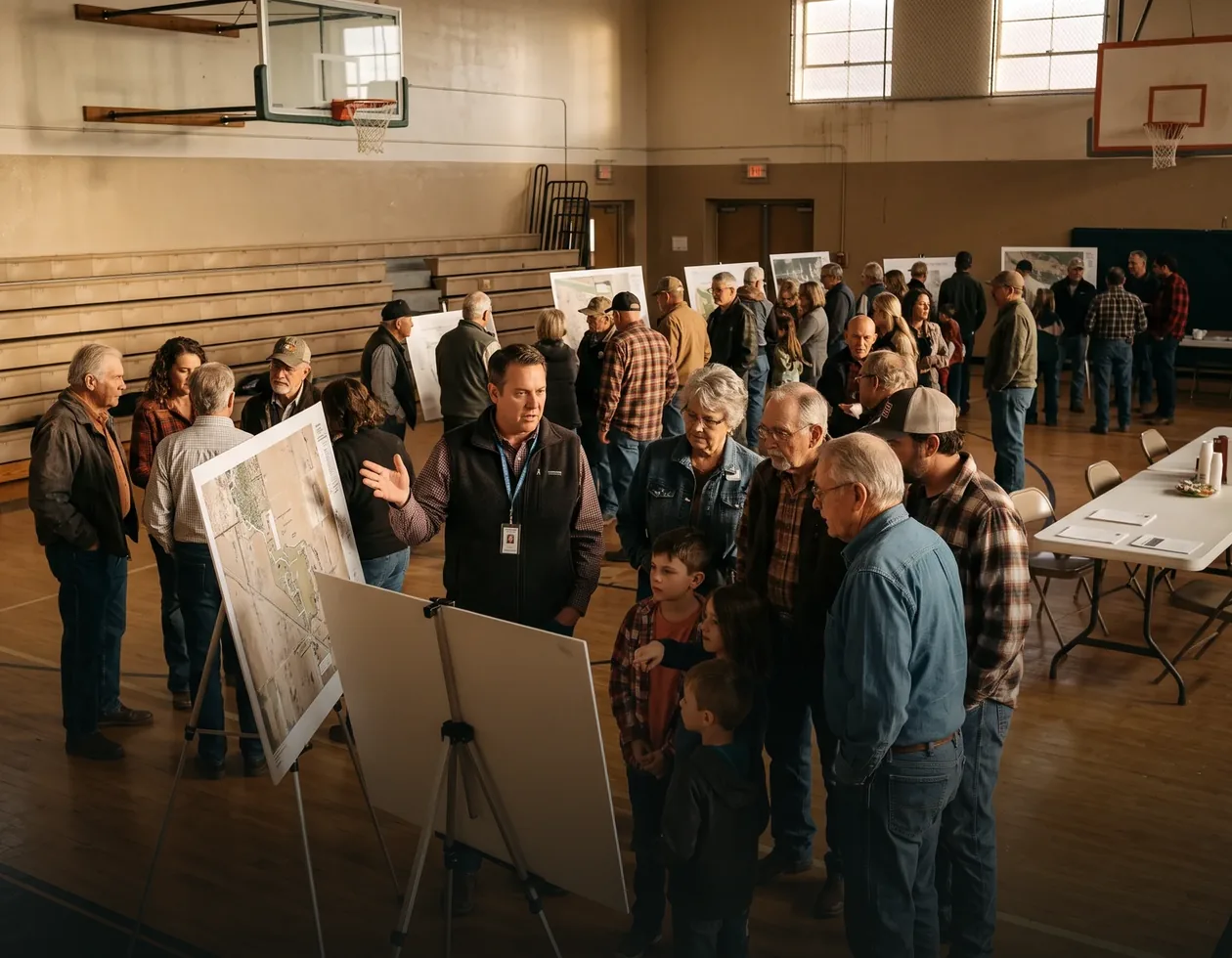
It is a low, quiet neighbour: panels sit about eight feet high on trackers and are screened with native planting where homes face the fence. We share the site plan at open houses before the county hearing, and change it when neighbours point out something we missed.
Very little. Across our fleet it averaged 0.02 litres per kWh in 2025, because robotic dry brushes clean 70% of our rows. The 2030 target is 0.01.
Most of them. 64% of our hires live within 60 miles of their site, and about 60% of each construction crew is hired in the county. Union crews build the plants; our own technicians run them for 35 years.
Things the county chooses: school programmes, volunteer fire stations, scholarships and water projects. Our community funds paid $7.8M in 2025 and $31M since we started — every grant is listed in the Impact Report.
More of it is stored than people expect. Our batteries hold 3.6 GWh today: they charge from our own solar in the afternoon and discharge into the evening peak, typically from 18:30. Another 2.4 GWh is being built.
Our own control room in Sandoval, 24 hours a day. Every site reports every five seconds, and fleet availability was 99.3% over the last twelve months. Call it on +1-555-0190.
Utilities, data-centre operators and other investment-grade buyers, under long fixed-price contracts. 92% of our revenue to 2040 is contracted that way.
Our sites use LFP battery chemistry in separate containers with spacing, monitoring and fire-response plans agreed with the local fire service before the first container arrives. Our 2025 TRIR was 0.21, against an industry average of 0.9.
On the Investors page: H1 2026 revenue was $386M and adjusted EBITDA $271M, with the Annual Report 2025 and the Green Bond Framework & Allocation listed there. Reported figures only; H1 2026 is unaudited.
The Q3 results call is on 6 November 2026 at 14:00 ET. Register through [email protected] — slides go up on the Investors page the same morning.
The 2024 green bond of $640M is fully allocated across nine sites, as set out in the allocation report. In October 2026 we closed $1.3B of green project financing with eleven lenders for Kettle Basin and Arden Plains.
No. This website is for information only and is not an offer of, or a solicitation to buy, any security. Questions about our financing go to [email protected].
Thirty-eight: 14 field technicians, 9 in engineering, 6 in development, 5 in energy markets and 4 in corporate teams. Every role is listed on the Careers page.
No. Electrical or mechanical experience counts more — many of our technicians came from ranching, the military or the oil field. Every new hire starts with paid training at an operating site.
Field roles are based at or near a site in one of our seven states; office roles sit in Sandoval, Arizona. The control room runs 24/7 on rotating shifts.
Write to [email protected] with the role in the subject line and a CV or a few lines about your work. A recruiter replies within five working days.
Send a short capability statement through the contact form or to [email protected], marked "Supplier". Our procurement team reviews every one and keeps a register for each new build.
Yes, wherever we can. Fencing, earthworks, gravel, catering, lodging and vehicle service on every build start with businesses in the county.
Every supplier signs our code of conduct, and modules and batteries are traced back to their origin. How we check is set out in our Modern Slavery Statement.
Write to [email protected] with the purchase-order number in the subject. Invoices are paid on the terms in your contract.
Every reply comes from someone on the Terravolt payroll — usually the person who manages your site or your lease.
Press questions here, investor questions to [email protected]. Replies within one working day.