
Bifacial panels on single-axis trackers, sheep between the rows and a substation of our own. Dunmore Flats in Nevada is the model: 420 MW, running since 2021.
Our largest solar farm — built by a county crew and grazed by sheep from October to May.
Here is where Dunmore Flats' output went on the longest day of 2026. The trackers start the morning facing east, lie flat at noon and finish facing west — which is why the shoulders are so wide.
Panels lose a little output every year. We guarantee the floor to every buyer, publish the real number and replace strings that drift.
The team that builds a site runs it for the life of the contract — and long after the module warranty.
The control room sees every inverter and tracker row, and sends a crew before output slips.
Union crews, most of them hired in the county, and a schedule we hand the landowner on day one. A 400 MW farm takes about eighteen months from mobilisation to commercial operation.
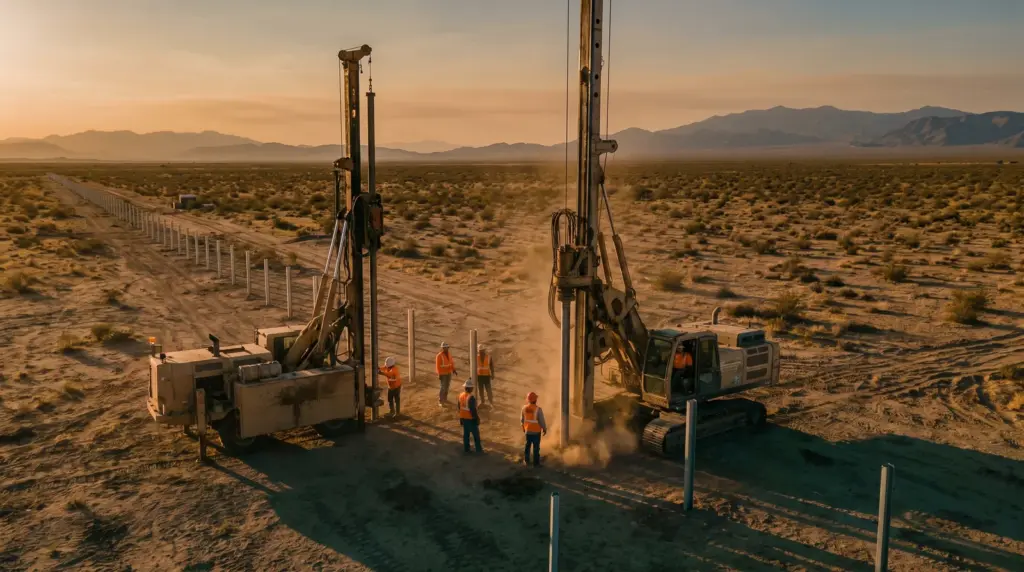
Access roads, laydown yard and fencing — wildlife-permeable along the boundary.
Steel posts driven to depth, torque tubes and drives on top — about a row an hour.
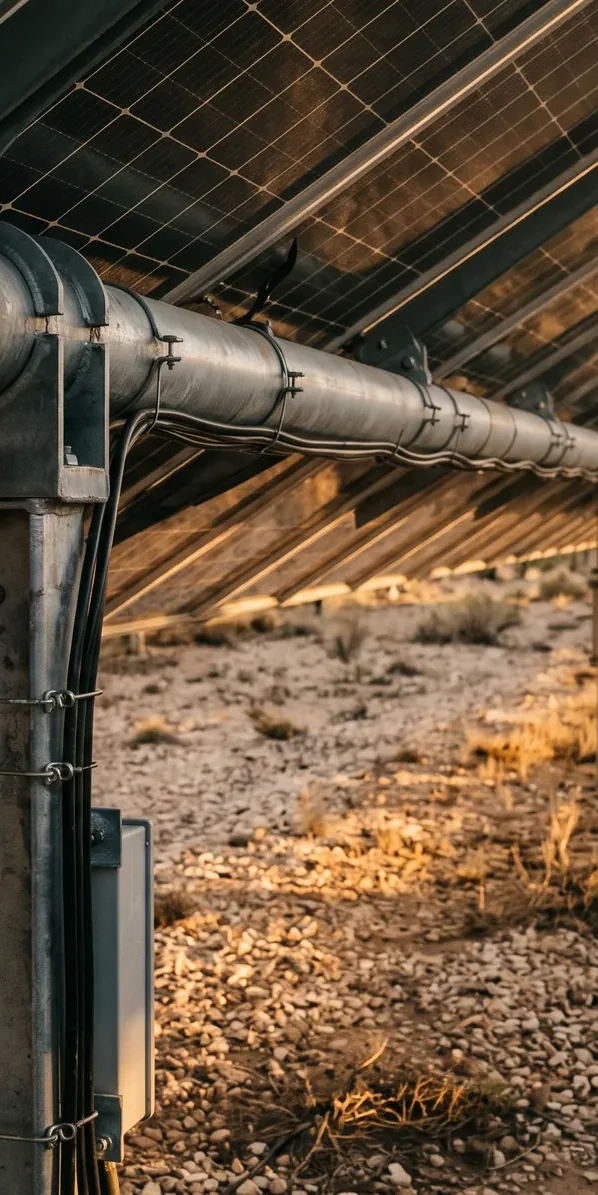
Panels clipped on, strings wired to the inverter skids and the substation energised.
Every block tested against the model, then commercial operation and handover to Sandoval.
The five questions landowners and counties ask most about a solar farm. The rest live on the FAQ page.
Roughly five to seven acres per megawatt with trackers, so a 300 MW farm needs around 1,800 acres. We lease rather than buy, and the land goes back to the family at the end.
Yes. 31% of the acres we run are co-used, with about 14,000 sheep across the fleet. Row crops between trackers are harder; we trial what the soil and water allow.
Removal is written into every lease and backed by a decommissioning bond. Panels, steel and cable are recycled where markets exist, and the ground is reseeded with a native mix.
Panels are silent; inverters hum faintly near the skid and are sited well away from homes. Modern module glass is made to absorb light, and we run glare studies for nearby roads and airfields.
Utilities, cooperatives and corporate buyers, under long-term fixed-price contracts. 92% of our revenue to 2040 is contracted with investment-grade buyers.